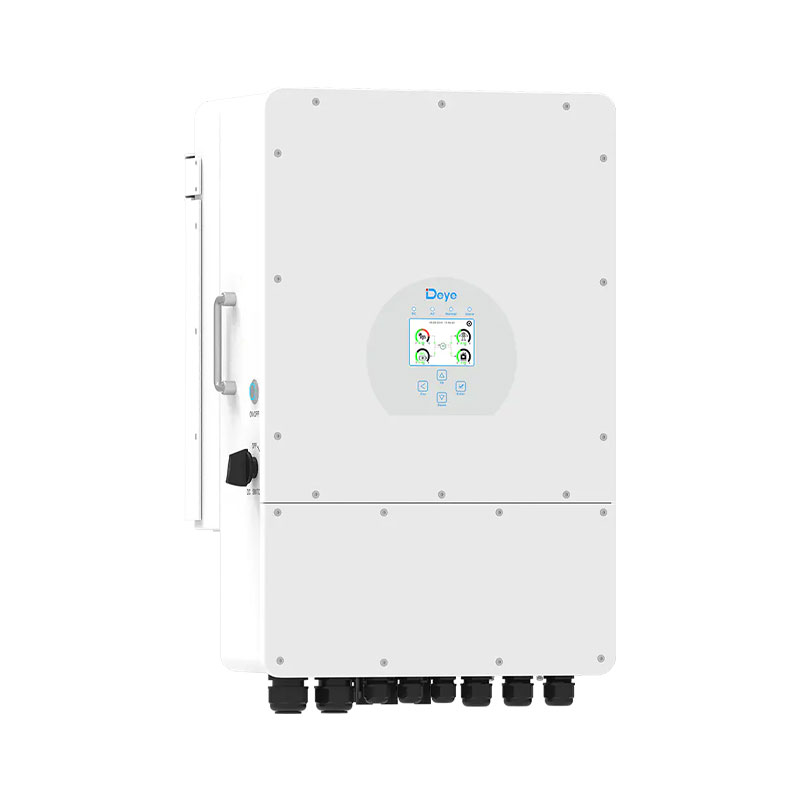
Deye Inverter F55 (DC-Volt High-Fault) Practical Analysis
Mar 28,2026F33 Is Not Always a "False Alarm": Why Phase Current, AC Coupling and Transient Loads Matter
Mar 27,2026Which Household Appliances Can Be Connected to a Solar Power System?
Mar 27,2026Occitanie Photovoltaic Subsidies 2026 | Uniz Solar
Mar 22,2026Deye SE F5 Pro-C|Your Trusted Low-Voltage Home Battery
Mar 21,2026Technical Update
Deye SE-F Series Low-Voltage Batteries: What Changes Across the Range - and What It Means for Upgrades
27 February 2026 | Uniz Solar Technical Team

Deye has expanded its low-voltage (51.2 V) lithium iron phosphate (LFP) portfolio with the SE-F family, covering capacities from 5.12 kWh through to 16 kWh. For customers who have used earlier Deye packs such as the rack-style SE-G5.1 Pro-B or the RW-F16 wall battery, the question is straightforward: what has changed, and which model fits which job?
This note summarises the SE-F line-up, explains the L/E/C configuration versions, and highlights the practical differences between the newer SE-F models and the older platforms most commonly found in European residential projects.
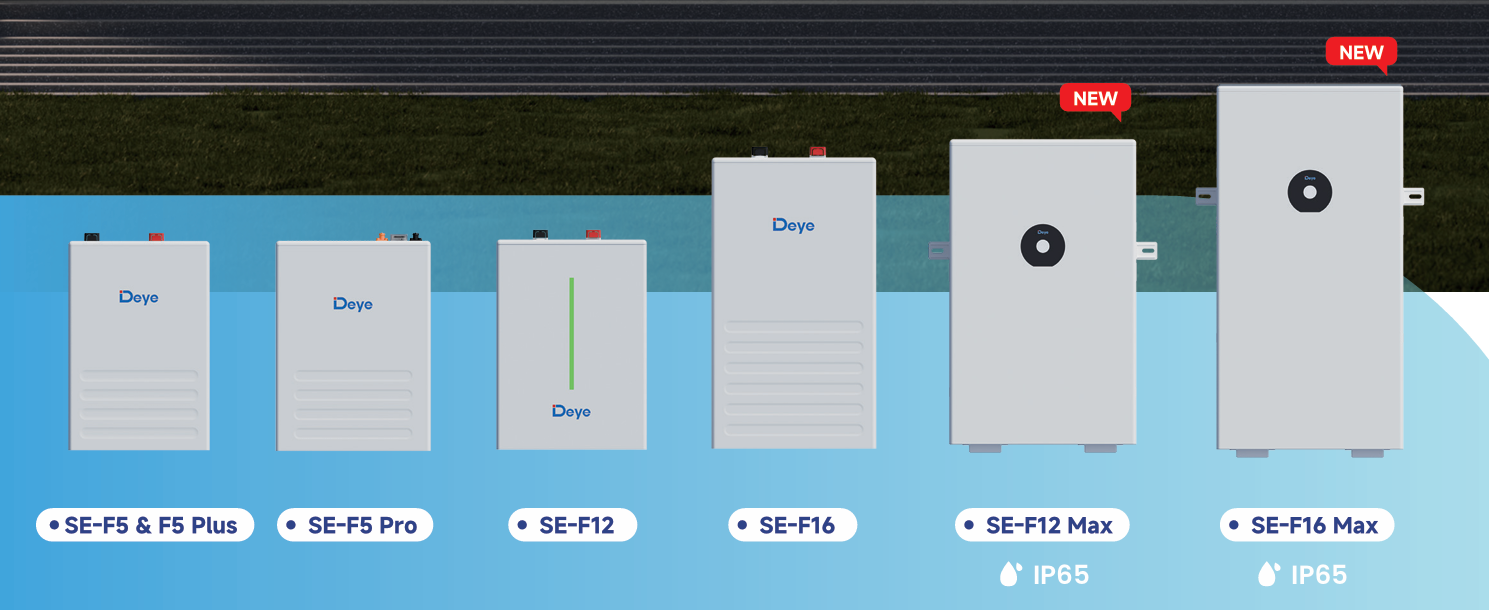
A quick map of the SE-F range
All SE-F models use LFP chemistry and communicate via CAN 2.0 and RS485. Each pack supports parallel expansion; Deye’s brochure specifies up to 32 units in parallel as standard, with larger parallel counts shown using a CAN bridge (system design and local approvals still apply).
|
Model |
Nominal energy |
Recommended DoD |
Cont. discharge |
Peak discharge |
Enclosure |
Warranty |
|
SE-F5 |
5.12 kWh |
80% DoD |
120 A |
150 A (10 s) |
IP21 |
5 years |
|
SE-F5 Plus |
5.12 kWh |
90% DoD |
120 A |
150 A (10 s) |
IP21 |
10 years |
|
SE-F5 Pro |
5.12 kWh |
90% DoD |
100 A |
150 A (120 s) |
IP21 |
10 years |
|
SE-F12 |
11.8 kWh |
90% DoD |
230 A |
280 A (10 s) |
IP21 |
10 years |
|
SE-F12 Max |
11.8 kWh |
90% DoD |
230 A |
280 A (10 s) |
IP65 |
10 years |
|
SE-F16 |
16 kWh |
90% DoD |
230 A |
280 A (10 s) |
IP21 |
10 years |
|
SE-F16 Max |
16 kWh |
90% DoD |
230 A |
280 A (10 s) |
IP65 |
10 years |
Notes: Current ratings are DC pack limits stated in the SE-F brochure; operating current is affected by temperature and state of charge. Where charge and discharge limits differ (for example, SE-F16 charge is 160 A while discharge is 230 A), system settings should follow the relevant datasheet.
What Deye emphasises in the SE-F platform
The brochure positions SE-F as an evolution in packaging and system behaviour rather than a change in chemistry. Several engineering points are repeatedly highlighted:
• Advanced BMS with an active fuse, aimed at improving fault protection at pack level.
• Higher-efficiency switching (GaN MOSFETs are cited in the brochure) and an integrated pack design intended to reduce internal line loss.
• Auto-networking and a local monitoring mode at battery level, with remote monitoring framed as part of a full ESS configuration.
• Natural cooling and an operating discharge range down to -20°C.
These are product-level claims in the brochure, but they point to the direction of travel: fewer external components, clearer commissioning, and more consistent on-site visibility of pack state.
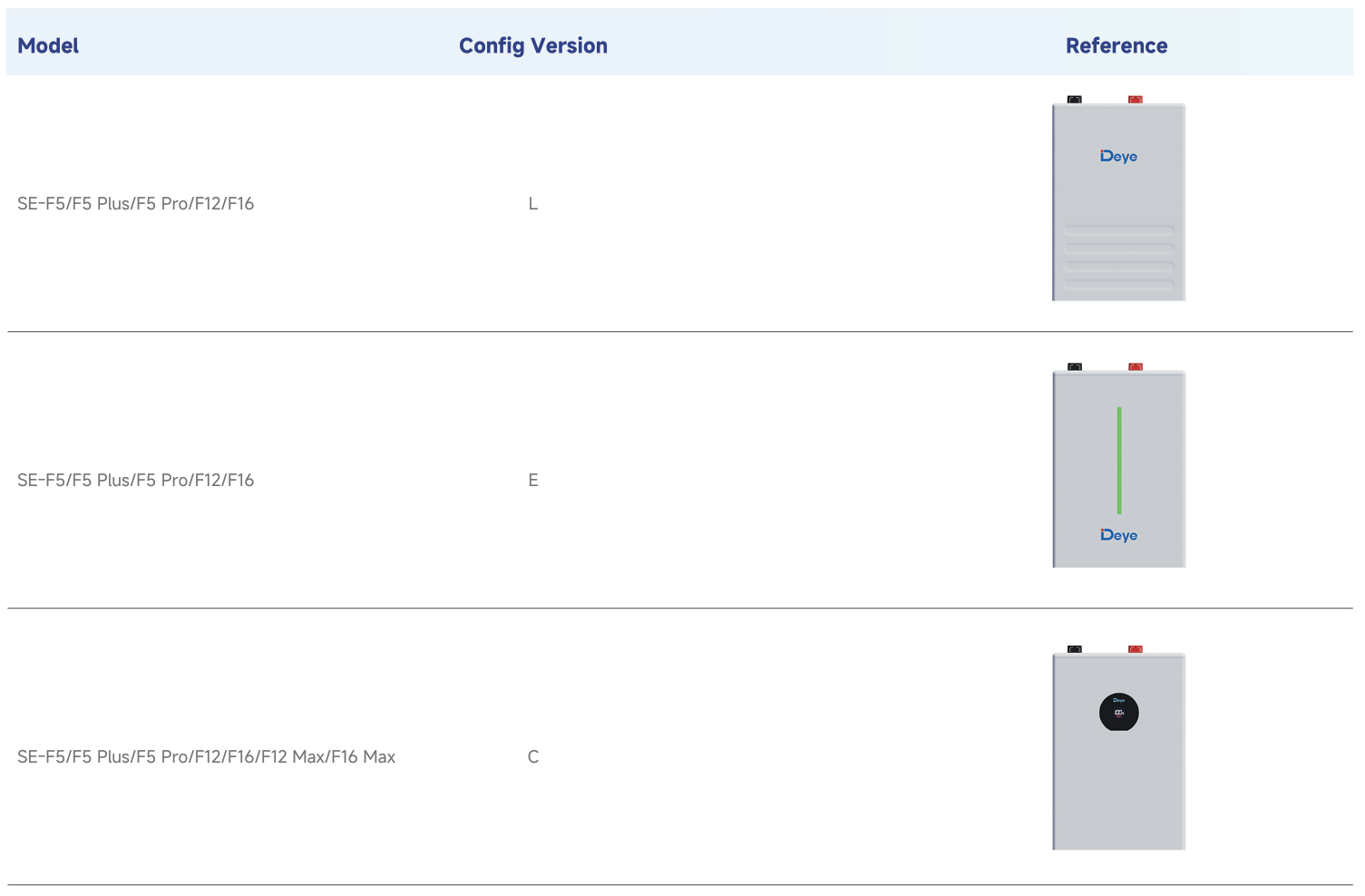
L, E and C configuration versions
Deye lists three configuration versions that primarily change the front-panel appearance and user indication:
• L: common version
• E: LED strip version
• C: display screen version
In the brochure, the C configuration is listed across the core SE-F5/SE-F12/SE-F16 products and is also used for the IP65 'Max' models. For procurement, treat L/E/C as a configuration code rather than a change in core battery capacity.

What the 'Max' suffix changes
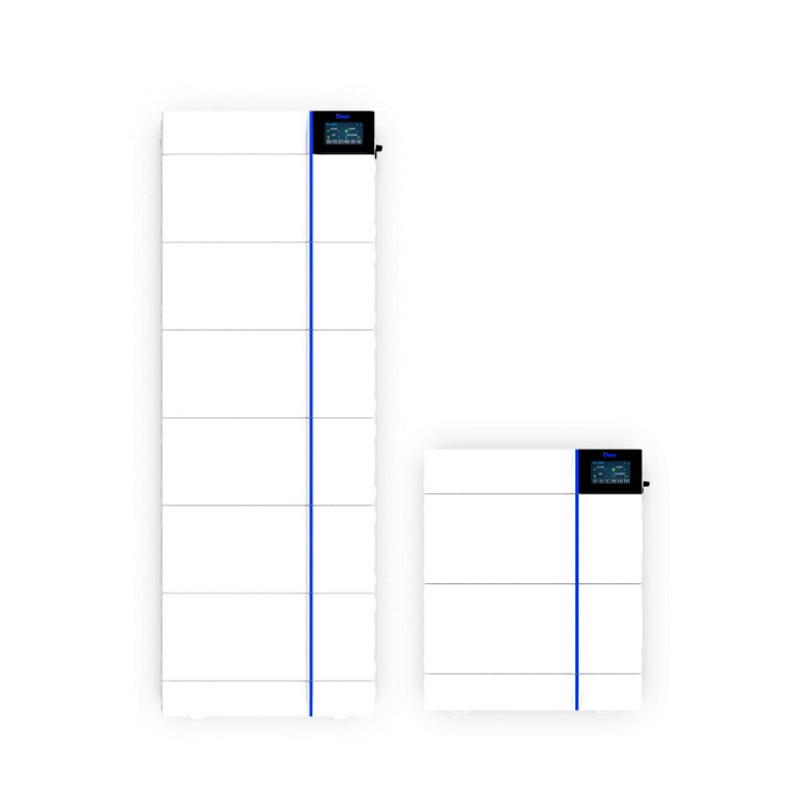
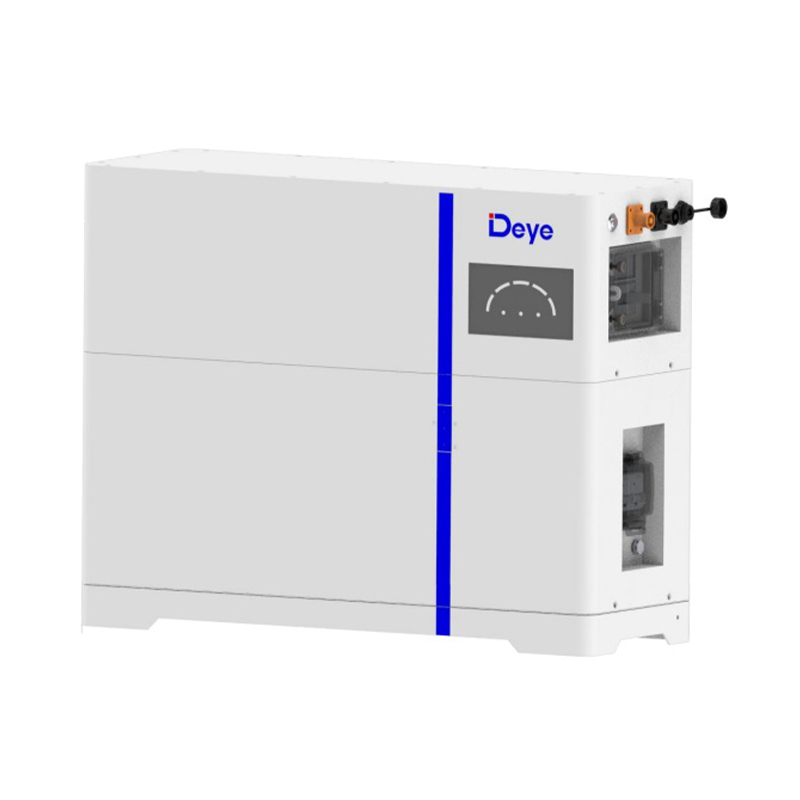
The SE-F12 Max and SE-F16 Max are positioned for installations where enclosure rating and user interface matter more than the base capacity. Compared with the standard SE-F12/SE-F16, the Max models add an IP65 enclosure and LCD status display. The brochure also notes optional heating on the Max variants to extend charging to -20°C (discharge remains -20°C to 55°C). Mechanically, the Max units are larger and heavier, and are shown with side outputs for power and communication (no junction box).
SE-F5 vs SE-F5 Plus vs SE-F5 Pro
At 5.12 kWh nominal, the three 100 Ah models are close on paper, but their lifecycle positioning differs:
• SE-F5 is the entry model with a recommended 80% depth of discharge and a 5-year warranty.
• SE-F5 Plus increases the recommended depth of discharge to 90%, extends the warranty to 10 years, and broadens the charging temperature range down to -10°C.
• SE-F5 Pro keeps the 90% DoD / 10-year positioning and adds longer peak current capability (150 A for 120 seconds). It also supports an optional monitoring module for WiFi + Bluetooth and app access, and the brochure includes a data-logger interface for local communications.
In short: Plus and Pro are better aligned with higher daily cycling expectations, while Pro adds integration features that are useful when commissioning larger parallel banks.
Scaling up: SE-F12 and SE-F16
The step from 5.12 kWh to 11.8 kWh (SE-F12) is primarily about fewer parallel units for a given site energy target. Both SE-F12 and SE-F16 remain in the same 51.2 V class, but differ in charging limits: the brochure lists 230 A continuous charging on SE-F12 and 160 A continuous charging on SE-F16. Discharge capability is listed at 230 A continuous with 280 A peak for short durations.
In practice, the 16 kWh unit is often used to reduce the number of packs required on higher-load single-phase systems, while keeping a familiar LV battery integration pathway with Deye hybrid and off-grid inverters.
Upgrade path: SE-G5.1 Pro-B to SE-F5 Pro
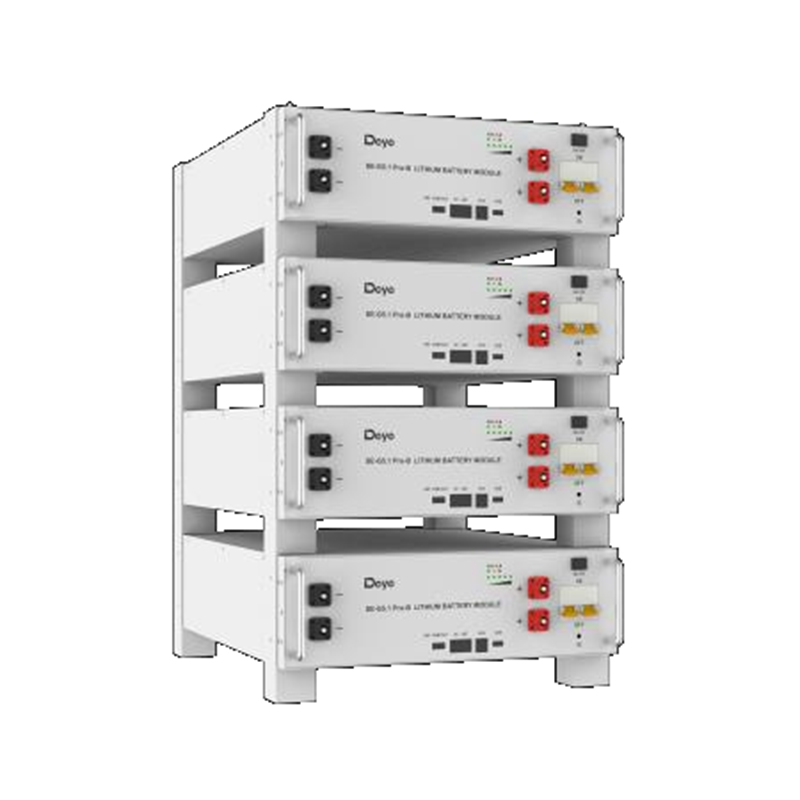
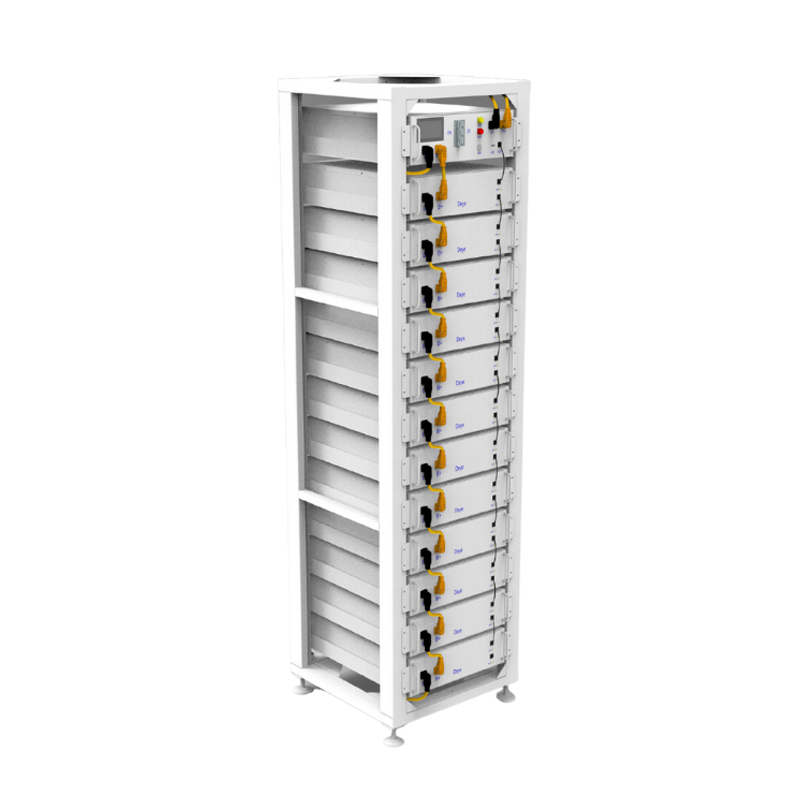
Deye’s SE-G5.1 Pro-B remains widely deployed in Europe as a 5.12 kWh rack battery. The newer SE-F5 Pro keeps the same 51.2 V / 100 Ah architecture, but shifts the product towards wall/floor/stack installation and adds an optional WiFi/Bluetooth monitoring module within the SE-F ecosystem.
|
Parameter |
SE-G5.1 Pro-B |
SE-F5 Pro |
|
Nominal energy / capacity |
5.12 kWh / 100 Ah |
5.12 kWh / 100 Ah |
|
Recommended DoD |
90% |
90% |
|
Warranty |
10 years |
10 years |
|
Cont. charge / discharge |
100 A / 100 A (max), 150 A peak (2 min) |
100 A / 100 A (cont.), 150 A peak (120 s) |
|
Enclosure rating |
IP20 |
IP21 |
|
Installation format |
Rack / wall / floor (19-inch cabinet support listed) |
Wall / floor / stack (stacking shown up to 6 layers for 5 kWh units) |
|
Monitoring / comms |
CAN 2.0, RS485 |
CAN 2.0, RS485; optional WiFi/Bluetooth module and data-logger interface; Bluetooth app on standard SE-F units |
Where the upgrade is felt most is in packaging and commissioning: the Pro-B specification is rack-oriented, whereas the SE-F platform is presented as a modular wall or stacked solution, with selection options that include indicator variants (L/E/C).
Upgrade path: RW-F16 to SE-F16
RW-F16 has been used as a high-capacity wall battery in off-grid and backup combinations. SE-F16 keeps the same 16 kWh class but updates the platform around warranty terms, monitoring, and expansion options (including stacked installation in the SE-F family).
|
Parameter |
RW-F16 |
SE-F16 |
|
Nominal energy / capacity |
16 kWh / 314 Ah |
16 kWh / 314 Ah |
|
Recommended DoD |
90% |
90% |
|
Warranty |
5 years |
10 years |
|
Enclosure rating |
IP20 |
IP21 (IP65 on SE-F16 Max) |
|
Charge / discharge current |
160 A / 160 A cont., 300 A peak (10 s) |
160 A cont. charge; 230 A cont. discharge; 280 A peak (10 s) |
|
Monitoring / comms |
CAN 2.0, RS485 |
CAN 2.0, RS485 + Bluetooth + APP |
|
Installation format |
Wall / floor-mounted |
Wall / floor / stack-mounted (up to 4 layers shown for 16 kWh units) |
|
Certifications (as listed) |
UN38.3, MSDS |
UN38.3, CE, CB (plus UL/FCC set on SE-F16 Max) |
For many residential sites, the headline change is the warranty and the move to a common SE-F monitoring experience (Bluetooth app), while the Max option addresses projects that require a higher enclosure rating.
Design notes for installers and system designers
Conclusion
Across the SE-F line, the main shift is practical: a more uniform installation format (wall, floor, and stacked options), clearer segmentation in the 5 kWh class, and an IP65 pathway through the Max models. For upgrades from SE-G5.1 Pro-B or RW-F16, the most visible changes are packaging, warranty terms, and on-site monitoring. Final selection should still be driven by the site environment (indoor vs outdoor), required current, and local certification requirements.
#EnergyStorage #BatteryStorage #SolarStorage #HomeBattery #LFPBattery #LiFePO4 #ESS #PV #Solar #RenewableEnergy #HybridInverter #OffGrid #BackupPower #SmartEnergy #SolarInstaller#Deye #SEFSeries #SEF5 #SEF5Plus #SEF5Pro #SEF12 #SEF12Max #SEF16 #SEF16Max #IP65 #SEG51ProB #RWF16 #CANBus #RS485
+31610999937
[email protected]
De Werf 11, 2544 EH The Hague, The Nederland.
WhatsApp: +1 (917) 257 2995/Copyright © 2023 Uni Z International B.V. VAT: NL864303440B01 All Rights Reserved
Solar Energy Storage System Solutions and Products