BOS-B Pro-A3 Battery System Explained: Capacity, Cycle Life, Configuration
Jul 07,2026SUN-MPPT-L01-EU-AM8 and SUN-STS500L Specs Explained: 8 Channels, 500kW STS
Jul 07,2026SUN-100K-PCS01HP3 vs SUN-125K-PCS01HP3: Comparing Specs to Choose the Right PCS
Jul 07,2026Solar Panels EV Charging: How Many Panels You Need & Full Setup Guide
Jun 30,2026Whole Home Backup System: AC vs DC Coupled, Cost & Sizing
Jun 24,2026Content
The SUN-MPPT-L01-EU-AM8 and SUN-STS500L sit on opposite ends of the same C&I ESS cluster. One pulls energy in from PV strings and hands it to the PCS as efficiently as possible. The other decides which power source — grid, generator, or the PCS itself — actually reaches the load. Neither replaces the other, and understanding where each one's job starts and stops makes it easier to size a system correctly.
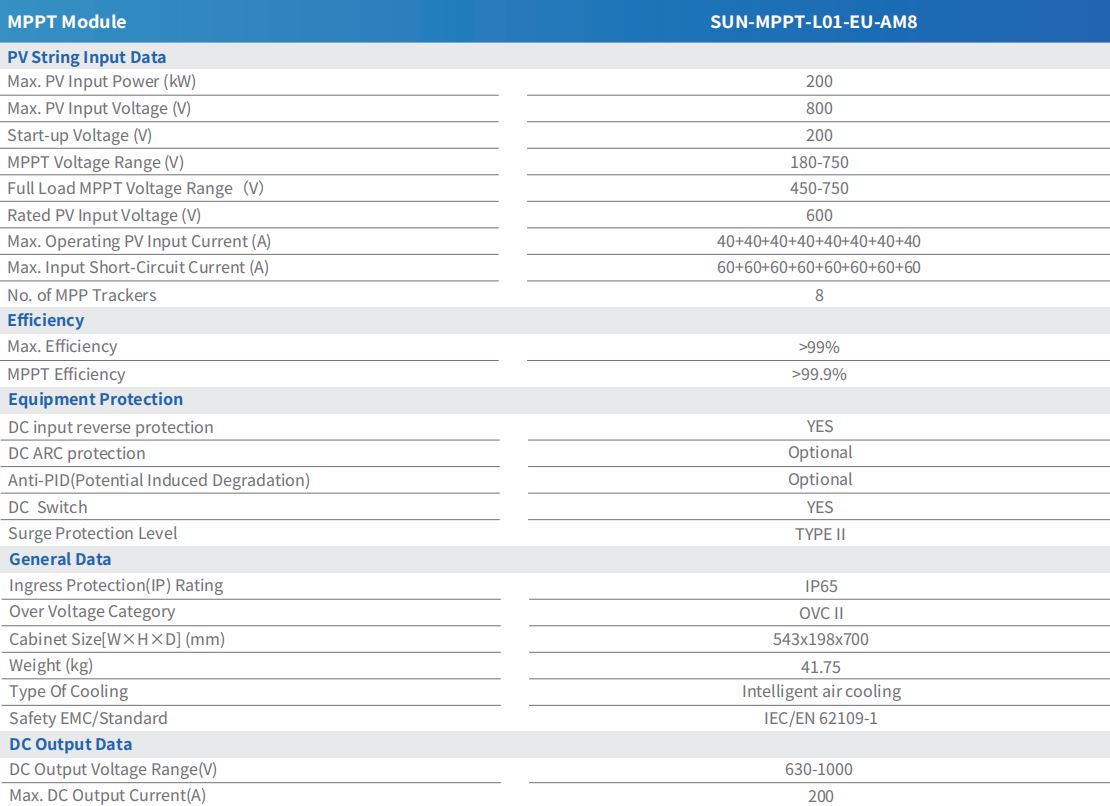
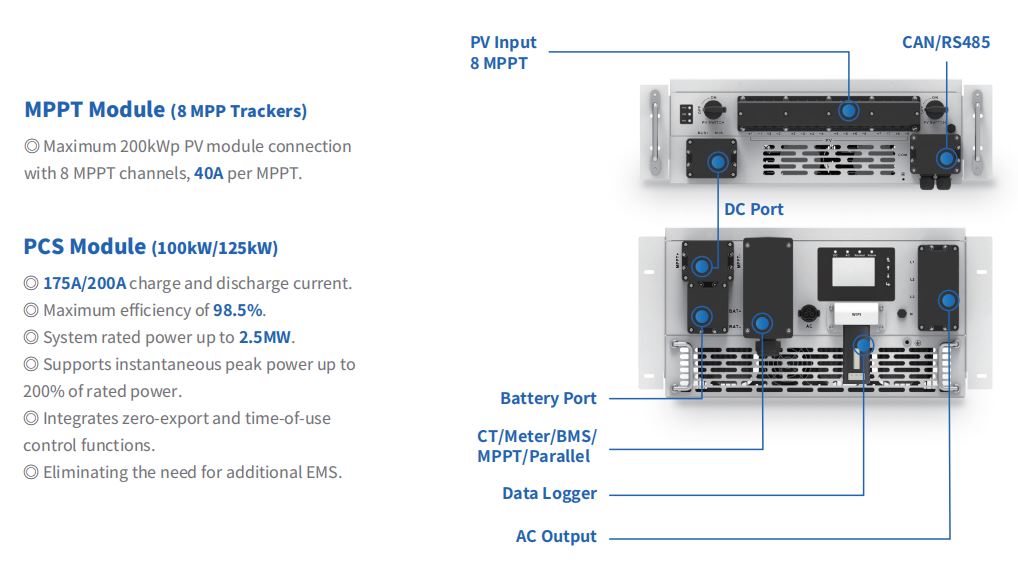
This module runs 8 independent MPP trackers, each rated for 40A of operating current and a 60A short-circuit current limit, for a combined maximum PV input of 200kWp. Because the trackers are independent rather than grouped, a shading event or a fault on one string is isolated to that channel instead of dragging down the other seven.
Voltage windows matter as much as the tracker count. Start-up voltage is 200V, the MPPT voltage range runs 180-750V, and it narrows to 450-750V under full load. Rated PV input voltage sits at 600V, and DC output feeds into the PCS at 630-1000V, capped at 200A. Maximum efficiency is rated above 99%, with MPPT tracking efficiency itself exceeding 99.9% — the difference between the two numbers being how well the module finds and holds the actual peak power point as conditions shift. For readers who want the underlying concept explained in more depth, this overview of maximum power point tracking and why it matters covers the fundamentals.

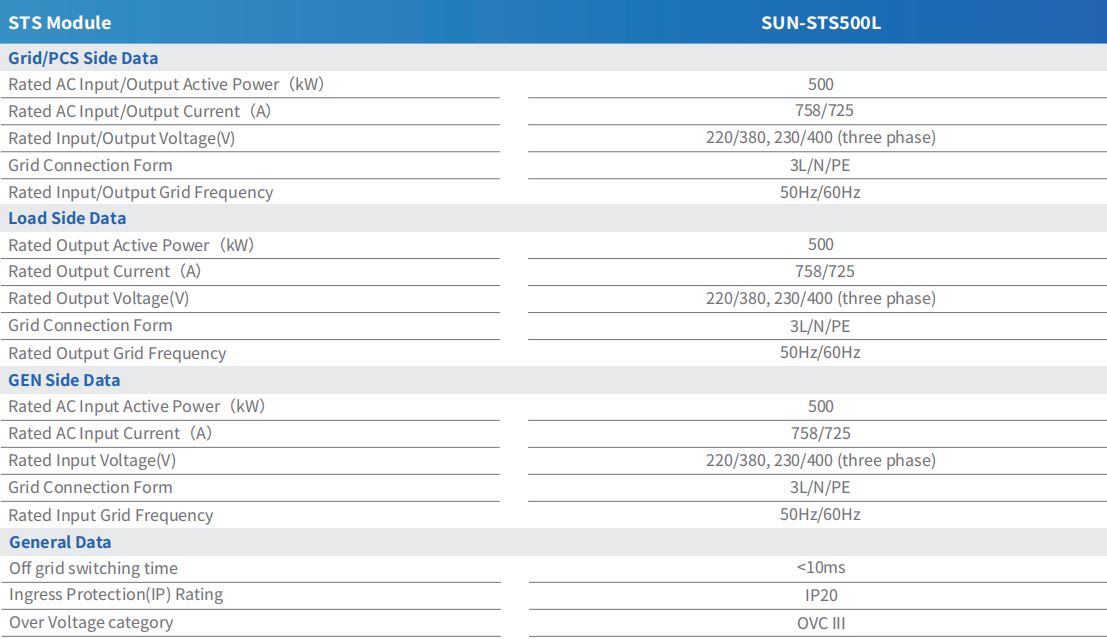
The SUN-STS500L is built around a single number: a 500kW switching capacity, applied identically across its Grid/PCS side, Load side, and GEN side. Each side is rated for the same 758A/725A input or output current at 220/380V or 230/400V three-phase, connected in a 3L/N/PE configuration at 50Hz or 60Hz.
Off-grid switching time is rated at under 10ms, which is fast enough that connected loads generally don't register the transition between grid, off-grid, and diesel generator modes. The module carries an IP20 ingress rating and an OVC III overvoltage category, reflecting its role as an AC-side switching component rather than an outdoor-rated enclosure.

In a typical build, PV strings terminate at the SUN-MPPT-L01-EU-AM8, which feeds the PCS on the DC side. The SUN-STS500L sits on the AC side, downstream of the PCS, deciding whether the load draws from grid, PCS-backed battery power, or a diesel generator. One STS500L unit connects to up to five 100kW PCS units or four 125kW PCS units, so the MPPT-to-STS ratio in a cluster follows however many PCS units are wired into that single STS module.
This split matters when troubleshooting: a PV underperformance issue points to the MPPT module and its tracker-level data, while a switching delay or mode-transition fault points to the STS module and its AC-side wiring. Teams speccing a full cluster around these two modules can review the complete C&I energy storage system lineup to match PCS count and battery capacity to the MPPT and STS ratings above.

←
BOS-B Pro-A3 Battery System Explained: Capacity, Cycle Life, Configuration
→
SUN-100K-PCS01HP3 vs SUN-125K-PCS01HP3: Comparing Specs to Choose the Right PCS
+31610999937
[email protected]
De Werf 11, 2544 EH The Hague, The Nederland.
WhatsApp: +1 (917) 257 2995/Copyright © 2023 Uni Z International B.V. VAT: NL864303440B01 All Rights Reserved
Solar Energy Storage System Solutions and Products